

I need to start by being very honest about the topic of this post.
I ran my own agency for ten years and I only had this realisation about half way through that experience.
There are only three ways to grow an agency:
- Retain your existing clients.
- Grow your existing client accounts via cross and upselling.
- Close new business.
It sounds obvious now that I say it, but when I found this level of clarity, it helped me become much more effective at my job.
To continue with the honesty, I think one of the reasons that I missed this clarity for so long was because I was heavily focused on the culture of my agency.
This wasn’t wrong as such, but there comes a point where culture only gets you so far. Having clarity on the true growth drivers of my agency PLUS a strong focus on culture is the combination that you need to grow.
Can you do it without a strong culture? Yes, you absolutely can. Many agencies do – it depends on the kind of agency that you personally want to run. But that’s a topic for another day!
Today, we’re going to talk about what I believe is the most important growth driver – reducing client churn.
You don’t need all of them firing on all cylinders at the same time
Before we get into the details of how to reduce client churn, a brief reality check – you’re unlikely to have all three of these perfectly optimised and driving growth all at the same time. It’s definitely possible for periods of time when internal and external factors are all aligned in your favour.
Whilst unlikely, it’s okay for this to be the case. In my experience, just having two of them working really, really well can lead to strong growth. One of them working is okay but could mean that you stand still.
The real danger comes when all of them are working against you. This is why so many agencies struggled at the start of the pandemic:
- Clients were forced to leave because their own businesses were in trouble.
- Even if you kept them, cross and upselling was pretty much impossible.
- Sales pipelines dried up whilst businesses went into survival mode.
It’s normal for one of these drivers to be a bit quiet at any one time – such as your sales pipeline being a bit quieter than usual or client churn being higher than usual.
But if you can have the right systems and processes in place across all three, then they can “cover” for each other when times get hard or external factors beyond your control kick in.
Right, let’s take a deeper look at how you can reduce client churn and review two simple, but effective systems to help.
Two systems that reduce client churn
It sounds obvious, but so many agencies take client retention for granted (I did!) and don’t have the right systems and processes in place to increase the likelihood of clients staying with you.
Many agencies learn this the hard way because it’s pretty normal to have super high retention for the first 2-3 years after starting out. If you do good work, then you’ll keep clients and you’ll have that “new agency” feel to you.
But after this point, even happy clients can start to look at their options and wonder if they’d benefit from a fresh approach. So churn can hit you quickly in your third year of trading, even if you do good work.
It’s at this point that some agencies may start to actively address churn and try to be more proactive in preventing it.
Most don’t. They just keep going and spend more time on new business than retention.
Again, I’ve done it. It’s fine, really – don’t beat yourself up about it.
Instead, spend time putting the following basic systems in place.
Client RAG tracker
RAG = red, amber, green.
Each week, your team needs to be updating the status of each client so that you can spot problems as early as possible and take action where needed. The things that you can score them against can vary, but I typically recommend that each week, the client lead marks them red, amber or green on:
- Delivery – are we on track to deliver what we said we would?
- Results – are we on track to deliver the results that the client expects?
- Happiness – does the client seem generally happy or have they raised concerns?
I’d recommend tracking this week on week so that you end up with a view of clients over time. If a client is on red or amber for a prolonged period, you need to be able to see this easily and prioritise fixing things.
The format is really up to you, but a simple spreadsheet like the following can work well:
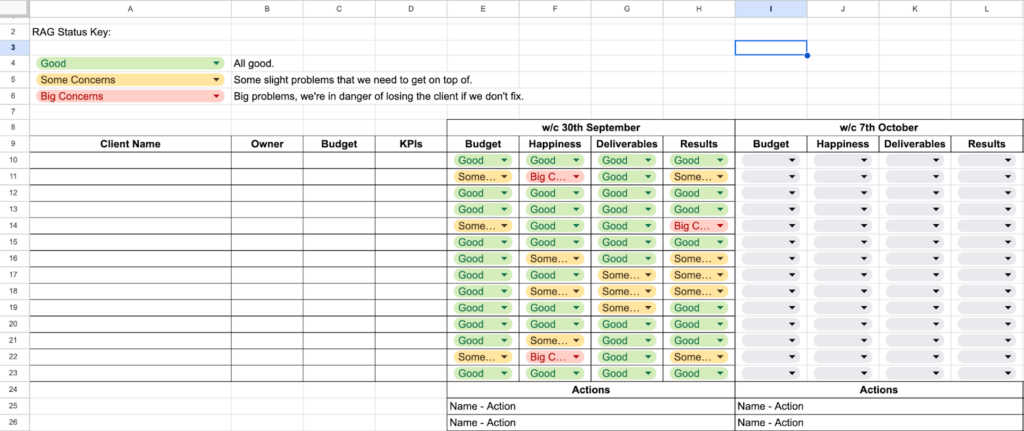
The key is keeping it up to date, accurate and then taking actions as a result of potential risks.
Doing this can help prevent churn simply by catching issues as soon as possible and doing something about them.
Client renewal tracker
Again, very simple but easily missed.
If you work with clients on a fixed contract term (as opposed to rolling) then there will be a date at which they need to decide whether to keep working with you or not.
Most agencies let this date creep up on them and a few things happen:
- The team is scrambling to put together a deck for a renewal meeting and feel on the back foot.
- It feels like a success to just keep the client, whereas the goal should really be (in most cases) to try and grow the account.
- You end up going past the contract renewal date and making a call between continuing to work out of contract whilst you wait for the renewal, or having to pause work. Neither are ideal.
Once you have the tracker in place, you can also set simple calendar reminders to tell you when a contract is coming up for renewal. I personally recommend these reminders being sent around 3.5 to 4 months in advance of the contract expiry date.
This may sound like a long time, but the reason for this is that most agencies will do quarterly reviews with clients. So if you have this reminder set up, you can go into at least one quarterly review in advance of the contract expiry with the goal of setting up the renewal meeting.
You can start to plant seeds about the renewal, potential growth, spotting potential issues or reasons why the client is unhappy which you can resolve in advance of the renewal itself.
Again, the tracker itself can be very simple and a spreadsheet can do the job. I’d recommend listing all clients along with the following information:
- Account lead/manager.
- Current budget.
- Target growth budget (if applicable).
- Service(s) they use (useful for seeing where cross sells are possible).
- Contract renewal date.
You can get more complicated if you want to, but just the above will get you started. The key is getting this information into one place, setting the reminders and then working with your team to manage the renewal process.
If you have any questions on any of this, just hit reply and I’ll get right back to you.